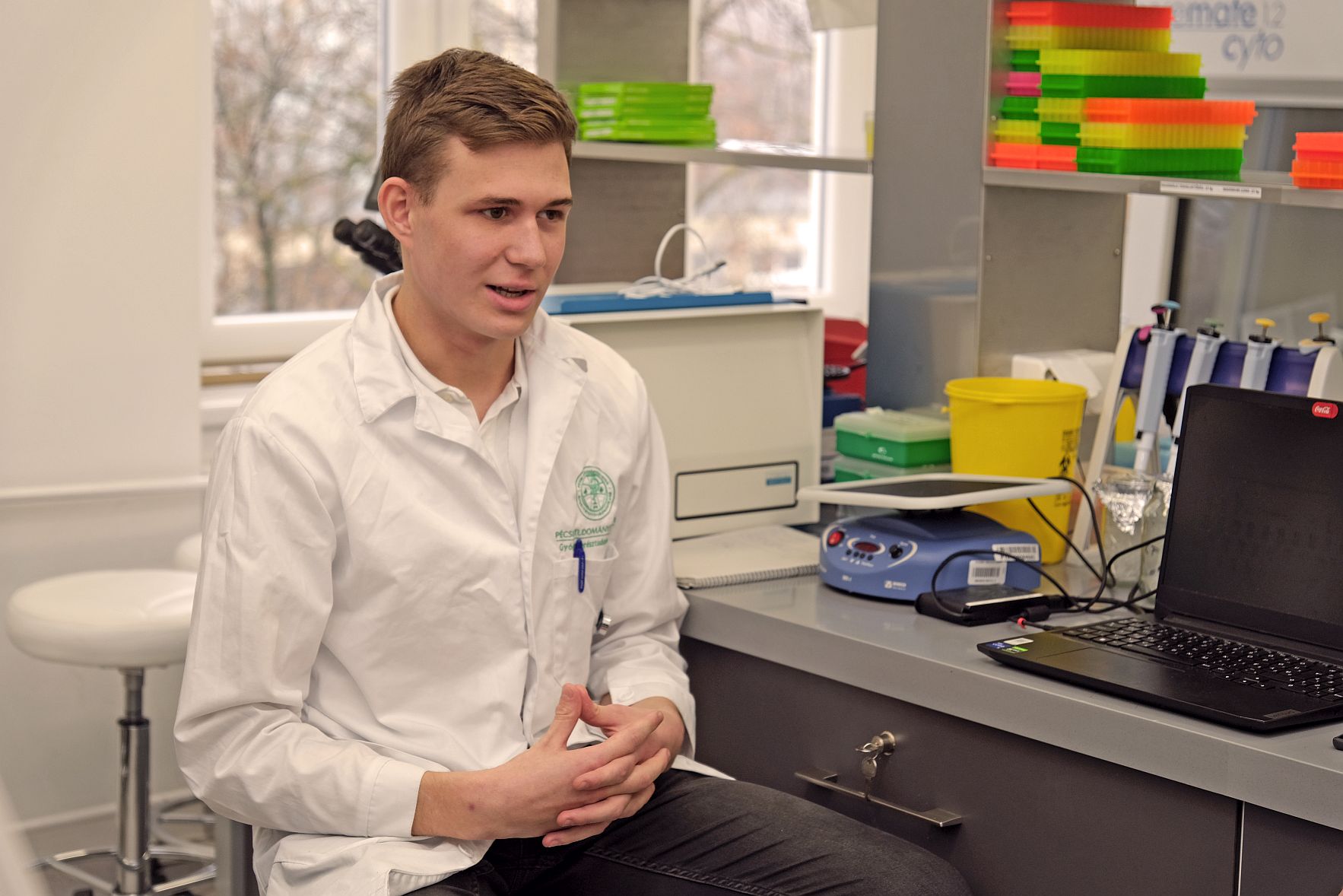
That might be a slight exaggeration, but Csongor Kásádi lives his life in fiction, as printing living tissues and its incredible potential still feels like science fiction nowadays. Despite his young age, the biotechnology student at the Faculty of Pharmacy in Pécs already has significant scientific achievements, which is hardly surprising, because he highlights the fact that everyone becomes a researcher here.
Written by Miklós Stemler
It might sound like a cliché that a person is destined for a particular career, but that is exactly what comes to our mind when we first meet Csongor Kásádi in the tissue-printing laboratory of the Department of Pharmaceutical Biotechnology at the University of Pécs Faculty of Pharmacy. Although these devices may be unusual for non-experts, such as bioink, tissue printers and bioreactors, the third-year student moves with ease among them. He speaks about tissue printing and presents his own research with enthusiasm, making the impression that he was truly meant to become a biotechnologist.
A chance encounter
His destiny was decided a few years ago at the Open Day of the University of Pécs Medical School and the Faculty of Pharmacy. Csongor was only at 11th-grade at Leőwey Klára Secondary School, and he was still thinking about his options for further studies regarding medical studies and career in pharmaceuticals. At the stand of the Biotechnology programme, he learned that the programme provides also the opportunity to print living tissues, so he instantly became open to this field, and he came to the realization that, as a biotechnologist, he could pursue knowledge in a quickly developing and exciting field.
– Multi-generational families of pharmacists or physicians are not unusual, but this is not the case with biotechnology, since it is a relatively new field of study. Modern biotechnology has only existed since around the 1980s with key fields, such as agriculture, food industry, pharmaceutical and medical biotechnology. Its dynamic and exciting nature got my attention. – Csongor recalls the first impressions from nearly four years ago.
Tissue printing, in other words the creation of living tissue, and setting it in 3D form like 3D printing is a relatively new subfield even within biotechnology. The genetic revolution that underlies the basis to it, and the breakthroughs in stem cell research took place in the 2000s. Technology has developed significantly over the past two decades, but still many challenges remain before being able to reach one of the main goals, which is to create fully functioning human organs. This is an ideal field for a young researcher, so Csongor became involved in this fascinating world almost immediately after starting the university.

– Once someone starts studying biotechnology and dive deeper into this field, no one would question their career path: everyone becomes a researcher here. In the first period, one must acquire the necessary theoretical basis, but the programme is mostly practical, and it provides outstanding training regarding molecular biology techniques.
Crash course in tissue printing
After learning the theoretical basis, Csongor started to do research immediately. New methods and technological breakthroughs follow one another rapidly in the field of tissue printing, and the team at the Department of Pharmaceutical Biotechnology also take their part of this progress, as well. Considered to be simpler tissues, such as skin, bone, and cartilage, can already be produced. Researchers mainly focus on challenges like printing tissues having functional network of blood vessels or creating more complex 3D structures, but enormous quantity and diversity of cells required for this work means one of the fundamental challenges.
– An adult human body has more than thirty trillion cells, and even creating the simplest tissues requires millions or tens of millions of cells. Moreover, each tissue contains several cell types, and they must be placed next to each other when producing the tissue. – Csongor outlines the basic challenges. The solution might be simple: we take the bioink and fill it into the tissue printer.
– The bioink contains the necessary cells for creating the given tissue. These materials are similar to gelatin, and apart from living cells, they also consist of nutrients in a hydrogel scaffold in order to help them survive and divide. The in vitro method means that tissues are produced under laboratory conditions in Petri dishes, and the aim is to reproduce the environmental factors in the body. The other in vivo method is when tissue printing takes place directly in the body, which gives the opportunity to treat larger injuries by using the patient’s own cells during the printing process. – Csongor explains.
All of this might sound like science fiction for those who are less familiar with this field, and it is important to note that these are still experimental methods. It could be Csongor’s generation that turns these into reality. The theoretical phase is already behind us, and wound healing in mice has been significantly accelerated with this method.
.jpg)
One of the major challenges in printing tissues under laboratory conditions is creating 3D structures that replicate the structure of the original tissues and organs. The progress in this area has been tremendous: mini organs, or so-called organoids are being produced also in Pécs, which can imitate the basic features of real organs. We are still far from producing implantable organs, but these are already extremely valuable when it comes to pharmaceutical research.
– Organoids make it possible to test different experimental medicines and compounds, which provides an alternative method to animal testing. This approach is far more humane than experimenting on animals, and more effective, because it has been proved that certain medicines work differently in primates than in humans. Pharmaceutical research can significantly speed up with using organoids and make the clinical phase safer. – Csongor says.
Csongor has already created such organoids under the supervision of his instructors, and as part of his thesis, he also built a bioreactor. These devices provide conditions similar to a living organism for the printed tissue. This is where 3D printing comes into play.
– The technology of tissue printing develops rapidly and has a great potential of experimentation, and we often face situations where we need objects or tools in the laboratory that would be expensive and time-consuming to obtain. We are able to solve this problem with a 3D printer, this way saves us time and money, and we can also create fully customized tools.” – Csongor demonstrates. Then he shows us a video explaining how printing a vascular network works in practice and how its permeability is tested with coloured saline. These are still experimental solutions, implanting the vessels, which are produced this way, into humans remains a future goal.
The age of explorers
The experimental atmosphere would remind us of the „garage” era of the 1970s and 1980s, when inventive young researchers and engineers let personal computer and global companies, such as Apple and Microsoft, come into existence. The comparison might not be fictional, as some experts believe that a similar revolution is unfolding in the field of biological technologies nowadays, similar to what happened in computer science.
Csongor shares this view, but he also adds that they are far from garage-like conditions. Sophisticated software and tools support their work, and laboratories must also comply with strict regulations. On the other hand, the garage mentality is still present in his work. His mentor asked him to create a customized supplementary tool for the bioprinter they use, because the manufacturer’s model was not suitable for them.

– This is about the so-called VasKit, which helps us to create vascularization in tissues. This is an essential part of tissue printing, as a vascular system is needed to supply nutrients and oxygen to the tissue. Since we had several problems with the bioprinter that we had been using regarding daily usability and sterilization, Professor Dr. Judit Pongrácz asked me to design and produce a device that would meet our needs. It did not take that many hours to design the VasKit, which is not only fully functional, but can also be made from materials found in any laboratory, therefore it costs less than the original device. The next step will be the 3D printing, and during software testing, I was able to identify problems that previously would have been only discovered during practical test. This also shows how sophisticated our programmes are, and overall, I have to say that it is a great time to be a biotechnologist. – Csongor says enthusiastically.
A certain future
Csongor, who receives his BSc degree this summer, did not imagine two and a half years ago that biotechnology would evolve from a subject into his passion. He says that his lecturers played a major role in this, especially his supervisor, Professor Dr. Judit Pongrácz, who supported him in every way and Professor Dr. Krisztián Kvell, Head of the Department of Pharmaceutical Biotechnology, who first introduced him to tissue printing. It is hardly surprising to hear that Csongor plans to build a career in biotechnology.
– I recently read an article stating that a significant proportion of the youth do not know nowadays what kind of work they will engage in, but I already have some idea. Of course, it is still impossible to know which field I will choose exactly or what new directions and opportunities may emerge in the future.
It is also not a surprising turn of events that Csongor already has plans for the next few years: after graduating, he will continue his studies with the MSc programme. A few years ago, he would not have imagined this at all.
– I chose Biotechnology BSc, because I did not want to study for five or six years, I thought that three years to obtain a degree would be enough for me. But as soon as I got here and started working in this field, this plan quickly changed. Research requires a higher level of training, so if you want to continue in this direction, completing the MSc programme is essential. I see this not as a burden, but as an opportunity. – adds Csongor, who also got the opportunity to be an intern last summer at the Regenerative Medicine and Cellular Pharmacology Laboratory at the University of Szeged.
After three, then an additional two years of study, Csongor will have every chance to take part in research that could have a significant impact on healthcare and, thereby, on everyday life.
– I believe the fact that illustrates progress well is that the project, which aimed to map the human genome, originally last thirteen years and cost around three billion dollars, but with next-generation sequencing methods it can be carried out in a day or two and the cost would be only a few hundred dollars. This would mean significant opportunities in personalized medicine and for those who pursue their careers as researchers in this field.
Photos:
Dávid Verébi, Csongor Kásádi